On Information Flows
Part one. Laying out the language

I.
It’s important to consider the information flow of systems. If your analysis doesn’t include a decent account of this domain, I will be dubious about it, just as I would be dubious of an analysis which ignores any other vital factor. Even if it is already implied, an analysis will be made stronger by including an explicit consideration. Information is just really important.
This article will cover the core aspects of information flow analysis, descriptively. A second installment will focus on some particular phenomena, particular factors, and some more concrete prescriptive points. These two posts are part of a larger project of laying out some useful analytic tools and their applicability for problems of socialist organisation, so you can expect something on organisational forms eventually. The intent is not to solve all the problems facing socialists in general form, but to outline the terminology of a discourse which can solve them. I’ve taken this approach because I often make reference to a concept which isn’t widely known, and that probably means my conversations would be more productive if they were widely known..
We can model complex phenomena as “systems” with a few stock components. This involves some simplification and standardisation, but is generally useful, and can be elaborated later if necessary.
A system has:
An environment;
Sensors which collect information inputs from the environment (eyes and ears, touch sensation);
A parser which transforms this input into legible form (the cerebellum);
A processor which uses this information and makes a policy decision or action (the brain);
Instruments, both physical and communicative, which produce an effect on the environment according to the decision (mouth and hands), and consequently an informational output.
So let’s call the change in an environment over time caused by a system an “informational flow”, or just a “flow.”
A system is finite. While there is a lot of variance between systems, all have only limited amounts of vision, memory, compute, and potential, corresponding to the components described above. This will be relevant later.
I won’t list many examples for each point, so keep some of the following examples of systems vaguely in mind, to concretely apply the ideas: economic planners, activist groups, corporations, administrators of organisations generally, animals, or maybe a newspaper.
II.
Each flow can be investigated in terms of its components, which will tell us something about how it works overall.
What are the sources of information?
How are they made legible?
How are they evaluated and used by the processor’s decisionmaking?
How does the decision affect the environment, the information inflow, and evaluation?
Information sources.
Obviously, it matters where information comes from. If sources are systematically biased, or data collection methods systematically inaccurate, the whole flow will be systematically wrong. Consequently, while it’s necessary to utilise what information inputs we currently have, it’s also vital to continually re-evaluate and monitor them. Among other ways, this can be done by taking a really close look (and consequently investing extra “vision” resources) into a case study, which can be compared to the ordinary observation to find blind-spots, overly low resolution images and such. A certain amount of “obvious” information will always be gathered, by osmosis from the most prolific news sources and evident facts, but a more relevant, precise, and accurate input of information will be highly valuable to the later stages for any complex operation.
Legibility.
This is a characteristic of information which makes it understandable to a processor. Information is more legible if it is central, short, and simple. Consequently, there are tendencies for any policymaker or administrator (taken in a very broad sense) to prefer quantitative statistics to qualitative studies, to seek to remove obstacles to information gathering, and even to standardise the environment to be more measurable. Legibility is a type of bias, and a certain amount of it is necessary for decision-making, one should be careful about the degree of simplification one is imposing, because it comes with a blindness for illegible realities, which nonetheless remain real. The result of this, in extremis, is Goodharting, when a system acts solely for the maximisation of its metrics to the detriment of its stated aims. For example, a farmer who wants to be productive might decide to aim for maximising the weight of his yield per acre, which is a nicely measurable quantity. Then he will grow the heaviest crops, overplant and overfertilise, resulting in the degradation of his soil and a bunch of unpleasant heavy plants.
Evaluation and decision.
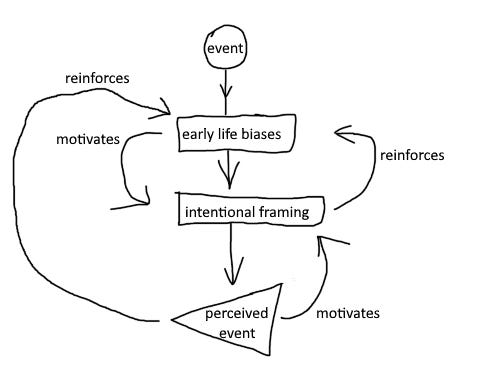
A processor must consider the information it receives, whether it should inform its decisions, and in what way, like an editor deciding what to keep and what to cut, in order to build a cohesive article. New information is combined with already-held knowledge, preferences, biases, norms, thought processes, decision procedures, and assumptions (I’ll collectively call these “priors”).1 In this combination, priors have significant value in providing structure and stability to the process, while pure improvisation is impractical and consequently rare; the ideal trade-off between exploration and exploitation depends on assessing the environment, and even if identified, the mechanisms to adopt it may be lacking or inhibited. It reduces compute (the amount of cognition required to perform a task), and can also generally improve the quality of a decision (by including more data). However, priors can be self-reinforcing, which will lead to the accumulation of an entrenched bias.
Execution.
This encompasses action which affects the environment and action which intends to primarily affect the information input of others (communication). In important respects the latter is only a special case of the former, since what one tells to the world, intentionally and unintentionally, will have an effect on the environment and fellow systems. While directed by the processor, actions are necessarily mediated (and flawed) by the available instruments, the means-of-effecting. The owner of a company may direct his managers to impose a new policy or practice, but this effort is conditioned by their competency, the recalcitrance of employees, unintended consequences, et cetera.
Capacity to act is, like the other capacities of a system, limited. The relevant variables are range and magnitude: a flow’s effect may be broad-weak, narrow-strong, broad-strong or narrow-weak.2
—
III.
Information loss refers to information which exists at one step but falls away in the next, either because it has been discarded or compressed. In a deterministic system like a Turing machine, any program has only one output, but any output can be produced by many programs. Consequently, given only the output (our observations), we can only make probabilistic guesses; the certainty of knowing the program’s details is denied us. This is analogous to the problem of interpreting the intent of an interlocutor, since many sentiments could produce the same statement. See also.
Sensing requires a definition of what to sense. No real system can access all possible information at once, so it is necessary to look at particular areas and facts, using its finite capacity to observe and record; naturally things which are more obvious are easier to observe, whereas the tiniest details won’t get picked up.
Legibility will always result in information loss. There are an infinite number of wavelengths of light, but only sixteen point seven million RGB values, and for everyday usage only about a hundred colour terms. These categories are very useful, it would be nightmarish or impossible to only speak in terms of exact wavelengths, but they are also lossy: they impose simplifications which mean we can’t glean as much information from the categorisation as we could from the original.
An efficient processor will evaluate and discard some information as irrelevant to its task, according to its decision-making policy. The communications of a flow will be a representation, rather than a copy, of the information that is desired to send, and the actions of a flow will produce effects.
IV.
Example 1. Phil encounters a painting, observes it, develops a feeling about it, and communicates it to Sally. She hears his opinion, and from evaluating his tone and word choice, combines it with her own knowledge and judgment to decide it’s a reasonable perspective, but not one that she shares; she decides not to communicate this, affirms his view, and moves on. The whole affair probably takes less than five seconds. Even in this example, there are also the decisions of the painter, the gallery curator, and the rest of the conversation; everything is a really complicated web of subprocesses, which is why we need to focus, compress, and filter information to get anywhere.
Example 2. A Minister of Economics views his country only through the lens of his metrics: GDP, employment, profit rates, and so on. The question of the day pertains to interest rates, so he decides to take inflation, employment, purchasing power and saving rates into account, ignoring the rest of his data. His decision is to cut rates; he perceives himself insofar as his action affects his metrics next week.
In conclusion, hopefully any of this was understandable. But really: when you’re thinking about a problem, or coming up with a solution, especially in socialist politics, pitch me on how it will improve our information situation. Don’t think we can just have the right ideas or take the right actions without considering who will learn that we have such or did so, whether it will lead them to join us, et cetera.
Keep records, define your decision procedures, seek to eliminate blind-spots, be careful of imposing legibility, and monitor what your actions and statements communicate to others. You’ll find eventually that things are easier once you do.
This can be likened to the distinction between constant and variable capital.
Examples of communicative equivalents of the above include: reaching a large audience with a not-very-detailed message, communicating deeply with close allies, a successful education campaign, or a niche poorly-written magazine.